
 800-948-3232
Change of Address Checklist: Everything to Update When You Move
FREE Moving Quote
"*" indicates required fields
A complete change of address checklist covers more than USPS forwarding. Filing in person is free. The online form carries a $1.10 identity verification fee. Standard forwarding only lasts 12 months. California requires a DMV update within 10 days of moving, covering your driver’s license and vehicle registration. Dozens of other accounts, from banks to insurance to your employer, need the update separately, since mail forwarding never covers everything.
Who to Notify Checklist
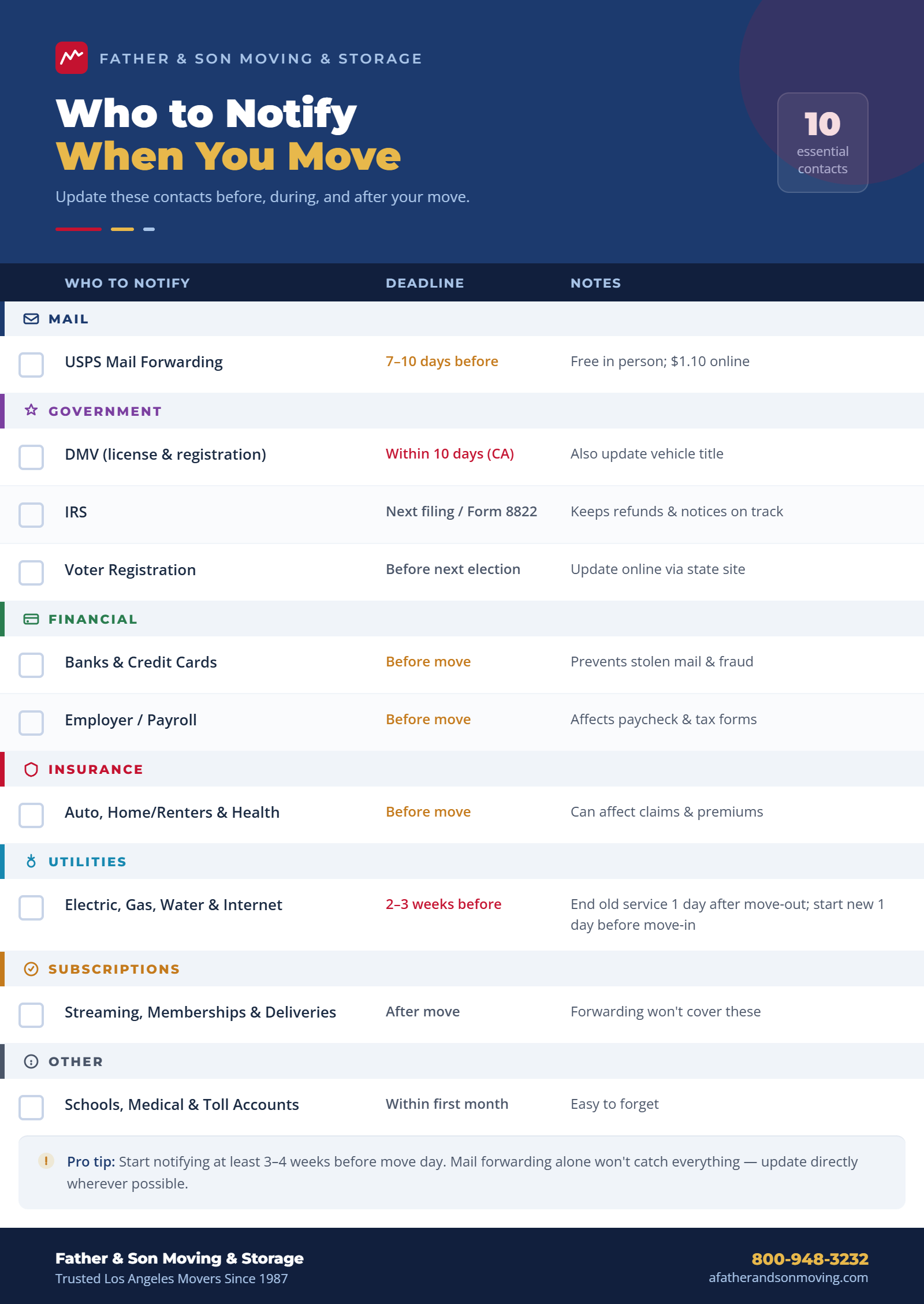
Why Does a Change of Address Checklist Matter?
Missing a single account on your change of address checklist can mean a lost bill, a denied insurance claim, or a fraud risk if your old mail lands with a stranger. USPS forwarding is a safety net, not a full solution: it typically lasts 12 months, and it does not cover packages, most marketing mail, or subscription deliveries. Every company and agency you deal with needs the update directly, sooner or later.
The risk isn’t evenly spread across accounts. A late streaming bill is an annoyance; a missed DMV update can mean a fine, a lapsed registration, or a driver’s license that expires without a renewal notice ever reaching you. A missed insurance update can complicate a claim at the exact moment you need coverage to work. Sorting your accounts by how much damage a miss would cause, rather than tackling them in random order, is what actually keeps a move from turning into a paperwork problem six months later.
A written plan also saves time during a move that already has enough moving parts. Knowing the full cost of moving before you start budgeting for new insurance premiums or utility deposits keeps both the paperwork and the finances under control at the same time.

When Should You Start Updating Your Address?
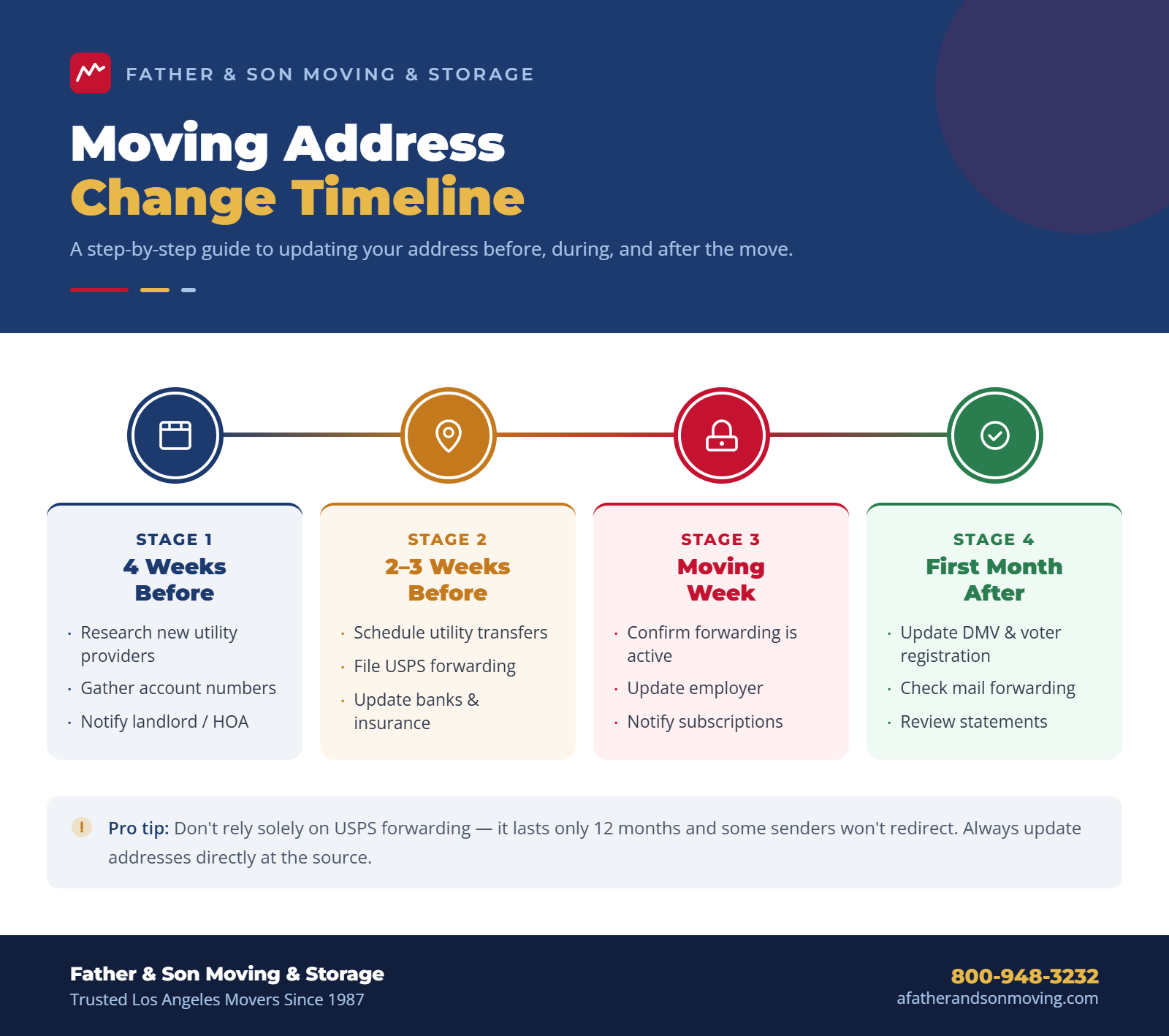
Timing matters more than most people expect. Start too late, and you risk a lapse in mail, utilities, or insurance coverage; start too early, and some updates won’t take effect yet.
When Should You Start Updating Your Address?
Timing matters more than most people expect. Start too late, and you risk a lapse in mail, utilities, or insurance coverage; start too early, and some updates won’t take effect yet.
The four-stage breakdown above works for most moves, but adjust it if your move is unusually fast or unusually far. A same-day or short-notice move compresses everything into a single week, so file USPS forwarding and schedule utilities the moment you have a confirmed date rather than waiting for the “ideal” window. A long-distance move, on the other hand, often means new state requirements for your driver’s license and vehicle registration, so check the new state’s DMV-equivalent agency as soon as your move-in date is set.
How Do You Change Your Address With USPS?
Filing a change of address with USPS is the fastest first step, and it’s the one most people already know to do. You can file in person at any post office for free, or online at usps.com for a $1.10 identity verification fee. Standard forwarding runs for 12 months, though you can request an extension for a fee if needed.
- File 7 to 10 days before your move so forwarding starts on time.
- Choose individual or family forwarding depending on who’s relocating; roommates or adult children moving separately each need their own form.
- Decide between temporary forwarding, useful for a short-term rental between homes, and permanent forwarding for a settled move.
- Remember that forwarding does not reliably cover packages, certain government mail, or subscription boxes.
For the official process, the USPS change of address page walks through both the in-person and online options step by step.

What Do You Need to Update With the California DMV?
California requires you to notify the DMV within 10 days of moving, which is one of the shorter windows in the country. This covers your driver’s license, vehicle registration, and vehicle title.
- Driver’s license: update your address online, by mail, or in person.
- Vehicle registration and title: both need the new address on file.
- Toll accounts (like FasTrak): update separately so automatic payments don’t lapse.
Missing this window can mean fines or a registration that lapses without you realizing it, since renewal notices go to the old address.
What’s Different If You’re Moving to California From Out of State?
Bringing a car and a license from another state adds a second set of deadlines on top of everything else on this list.
- Driver’s license: apply within 10 days of establishing California residency (CVC §12505). You’ll take the vision and written tests but skip the behind-the-wheel test if your current license is valid.
- Vehicle registration: register within 20 days of establishing residency (CVC §6700) — double the license window, and penalties start accruing on day 21.
- Smog check: required for most vehicles unless they’re within their first 8 model years; California won’t accept an out-of-state smog certificate.
- VIN verification: required for every out-of-state vehicle, free at a CHP office or AAA (for members), or $5 at the DMV.
- Old plates: California surrenders and destroys your out-of-state plates once you’re registered, so don’t plan on keeping them.
Bundling the license and registration into one DMV appointment is the fastest way through both deadlines, and if the move itself is still ahead of you, cross-country movers Los Angeles can get the truck scheduled around the same timeline.
Which Utilities Need to Be Transferred Before Moving Day?
Utility transfers are where most last-minute stress happens, mainly because people wait too long to schedule them.
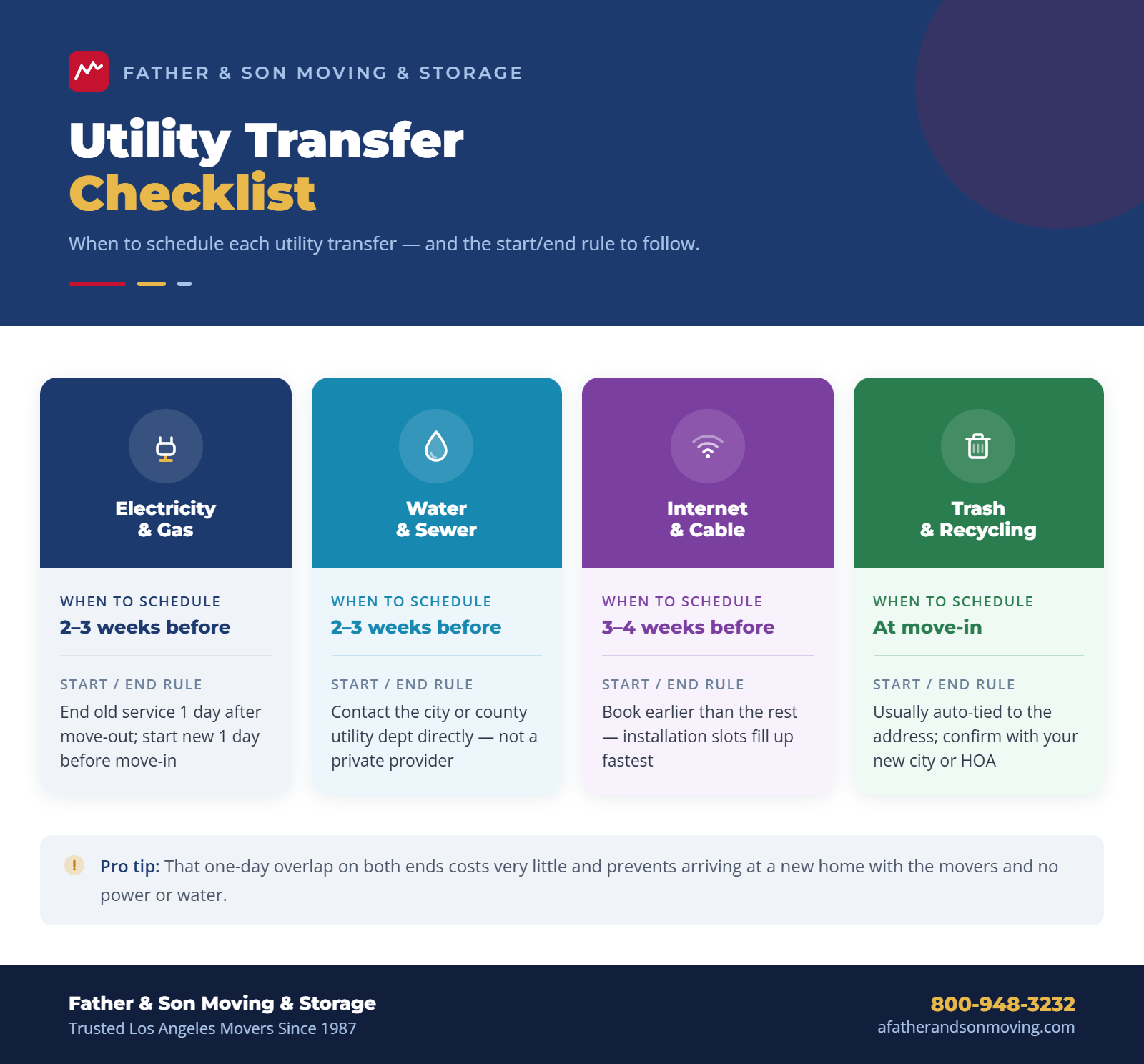
That one-day overlap on both ends costs very little and prevents arriving at a new home with the movers waiting and no power to see by.
In most of Los Angeles, that means coordinating directly with LADWP (Los Angeles Department of Water and Power) online or by phone, since the city runs both power and water for the majority of residents rather than a private utility. Surrounding cities like Burbank, Glendale, and Pasadena run their own municipal utilities, so double-check which department serves your specific address before you schedule anything.
Who Else Needs Your New Address?
Beyond government agencies and utilities, a long list of everyday accounts needs the update too, and they’re the ones people forget most often.
- Banks, credit cards, and loan providers, to avoid statements landing at your old address.
- Auto, home or renters, and health insurance, since an outdated address can complicate a claim.
- Your employer’s HR or payroll department, so W-2s and pay stubs go to the right place.
- Subscriptions and memberships: streaming services, meal kits, gyms, and loyalty programs.
- Schools and medical providers, especially if you’re moving with kids.
- Toll accounts like FasTrak, so automatic payments keep working without a lapse.
A simple way to catch anything you missed is to flip through the last two months of bank and credit card statements and list every company that’s charged you. Most of those companies let you update your address in a few minutes through their app or website, so this step is more about remembering to do it than any real difficulty.
If you also have belongings going into storage during the transition, our full-service storage option keeps everything secure while you work through the rest of the list.
What Documents Do You Need to Update Your Address?
Most banks, insurers, and government agencies ask for the same proof of your new address. Gather these once, and you’re not digging for them account by account.
- A signed lease or mortgage statement showing your name and new address.
- A recent utility bill (electric, gas, or water) in your name at the new address, usually accepted once service has been active for a few weeks.
- A government-issued ID — this is what the DMV updates, so it becomes your proof of address everywhere else once it’s current.
- Your moving company’s bill of lading or receipt, which some employers and smaller local accounts will accept as informal proof of your move date.
Keeping a folder, physical or digital, with copies of these four documents means you’re not searching for a utility bill every time a new account asks for proof.

Does This Checklist Change for Renters vs. Homeowners?
Most of the checklist is identical either way, but a few items differ depending on whether you’re renting or buying.
- Renters: notify your landlord or property manager of your move-out date in writing, request your security deposit refund in advance, and confirm your renter’s insurance policy transfers or cancels on the right date.
- Homeowners: update your address with your mortgage lender and homeowner’s insurance provider, and notify your county assessor’s office so property tax bills go to the right place.
- Both: HOA or condo association contacts, if applicable, need the new address for billing and any move-out inspection paperwork.
Families moving with kids have one more layer: school district paperwork and medical or dental provider records should move to the top of the list, since those transfers often take longer than a simple address update.
What Are the Most Common Mistakes People Make?
The same handful of mistakes show up on almost every list of things people forget when moving.
- Assuming USPS forwarding covers everything, then missing a bill that never got forwarded.
- Waiting until moving week to schedule utility transfers, only to find the installer is booked out two weeks.
- Forgetting toll accounts and transit passes, which keep charging the old address until updated manually.
- Updating the DMV but skipping voter registration, which most people don’t realize is a separate step.
- Not checking the next month’s bank and credit card statements to confirm the new address actually stuck.
Building your address updates into the same timeline as your moving day essentials list keeps both from slipping through the cracks in the last busy week.
What Happens If You Forget to Update Your Address?
Forgetting to update your address can lead to delays, missed notices, or financial issues. Common consequences include:
- DMV: Fines, registration issues, or missed renewal notices.
- Insurance: Claim delays or policy issues.
- Bank accounts: Statements sent to the wrong address, increasing fraud risk.
- IRS or state tax agencies: Delayed tax refunds or missed correspondence.
- Retail and loyalty accounts: Missed rewards, discounts, or deliveries.
Most issues are easy to fix by updating your address with the affected organization. The bigger problem is not realizing an account was missed until an important document, bill, or refund is delayed.
Ready to Check Moving Off Your List?
A change of address checklist keeps your move’s paperwork under control. Skip it, and missed bills or lapsed coverage pile up fast. Work through it a few accounts at a time. That’s what actually gets it done, not a last-minute scramble during moving week.
Father & Son Moving & Storage handles the physical side of the move, whether you’re staying local or heading out of state. Moving long-distance? Lock in your movers early. That keeps the timeline above lined up with your actual moving day.
Reach out for a free estimate and get your move scheduled around the checklist above.
D
David Probasco


Bravo. I must start by saying my husband and I have moved from Denver to Philly, twice moved in Philly, Philly to Hollywood, Hollywood to DTLA and now back to ...
Contact Us
"*" indicates required fields
